
Rhytidectomy (Facelift Surgery)

A rhytidectomy, more commonly known as a facelift, addresses visible changes that develop in the lower half of the face over time. Genetics, gravity, lifestyle and sun exposure all influence how facial skin, fat and muscle gradually change.
As skin loses elasticity and underlying tissues provide less support, the face can begin to look heavier or more tired. Sagging through the mid-face may deepen folds between the nose and mouth. Reduced muscle tone and volume in the lower face can lead to jowls along the jawline. Changes beneath the chin and jaw may also soften definition, even in people of a healthy weight.
Facelift surgery works to restore balance and structure rather than create a new or unfamiliar appearance. The intention is to help you look refreshed and more like yourself.
When a facelift may help
You may consider a facelift if you feel concerned about:
- sagging through the mid-face
- deepening folds between the nose and mouth (nasolabial folds)
- jowls along the jawline
- loss of definition in the lower face
- loose skin or fullness beneath the chin
A facelift improves visible signs of ageing in the face and neck, but it does not aim to remove every line or stop the ageing process.
A considered approach to facial lifting
A facelift repositions skin and deeper facial tissues to restore support and contour. Because ageing affects multiple layers of the face, effective surgery addresses more than skin tightening alone.
Ms Tzafetta plans facelift surgery with close attention to anatomy, proportion and how results will behave over time. Her approach prioritises natural movement and durability rather than short-term tightening.
Facelift techniques
Ms Tzafetta selects facelift techniques based on your anatomy and the degree of change required. Not every facelift follows the same approach.
Options may include:
- a traditional facelift, for more extensive sagging
- a limited-incision facelift, for more subtle changes
- a neck lift (lower facelift) when the neck contour contributes to facial ageing
- a deep plane facelift, which repositions deeper facial structures in selected cases
Ms Tzafetta may combine techniques when this improves overall balance.
Deep Plane Facelift
Some patients ask about a deep plane facelift. This technique refers to a specific surgical procedure that addresses deeper facial structures rather than simply lifting the skin.
In a deep-plane facelift, Ms Tzafetta works beneath the superficial musculoaponeurotic system, also known as the SMAS layer. By releasing and repositioning deeper ligament attachments, she can move the mid-face and jawline as a single anatomical unit rather than pulling tissues separately.
This approach may offer:
- improved mid-face elevation
- more natural movement
- reduced tension on the skin
- durable structural repositioning
However, deep plane surgery is not automatically better or necessary for every patient. Facial anatomy, skin quality, degree of ageing and surgical goals all determine whether a deep plane approach is appropriate. In some cases, a traditional SMAS-based facelift or a limited technique may achieve equally effective, more proportionate results.
Ms Tzafetta selects the surgical plane based on anatomy rather than on trend terminology. Her focus remains on long-term facial balance, natural expression and safe tissue handling.
During consultation, she will explain which approach suits your facial structure and why.
Facelift surgery
During facelift surgery, Ms Tzafetta elevates and repositions the skin and soft tissues of the face. Incisions usually follow natural creases around the ears and hairline to help scars heal discreetly.
She reshapes and redistributes fat where needed, repositions deeper facial tissues and muscles, and then redrapes the skin over its new support. Ms Tzafetta removes excess skin carefully to restore contour without tension. In some cases, a small incision beneath the chin allows additional refinement of the neck.
Facelift surgery usually takes between two and five hours. Ms Tzafetta typically performs the procedure under general anaesthetic, and an overnight hospital stay is common.
Your facelift consultation
Your consultation with Kalliroi Tzafetta provides the foundation for safe, thoughtful facelift surgery.
During this appointment, you can talk through the changes you have noticed and what you hope surgery might improve. The discussion focuses on clarity, realism and long-term outcomes.
Ms Tzafetta will:
- assess facial structure, skin quality and muscle tone
- review your medical history and any previous facial treatments
- explain differences in facial symmetry
- discuss suitable techniques and likely scar placement
- explain risks, recovery and realistic expectations
Some people find it helpful to bring a photograph from a time when they felt their face looked its best, as this can support discussion around goals.
Recovery and expectations
Recovery depends on the extent of surgery, but swelling, bruising and tightness commonly appear in the early stages and improve steadily over the first 2 to 3 weeks.
Many people feel ready to return to desk-based work after around 2 to 3 weeks, although some visible swelling may persist. Roles involving physical work or public-facing responsibilities may require additional time away. Ms Tzafetta will give personalised advice based on your surgery and occupation.
Strenuous exercise usually resumes after 4 to 6 weeks, once healing has progressed safely.
Final results continue to develop over several months as tissues soften and settle.
A facelift aims to create a refreshed, natural appearance rather than a pulled or artificial look.
Understanding limitations
A facelift restores facial support and contour, but it does not stop the ageing process or remove all fine lines, particularly around the mouth.
Ms Tzafetta may discuss additional treatments, such as fat transfer (lipotransfer), dermal fillers (injectable volume treatments) or skin resurfacing, when these help improve overall balance. Each treatment plan reflects individual anatomy and goals.
A specialist, measured approach
Under the care of Ms Tzafetta, facelift surgery centres on anatomical precision, facial harmony and durability of results.
Her background in reconstructive and facial surgery supports a careful, evidence-based approach that prioritises safety, realism and long-term satisfaction.
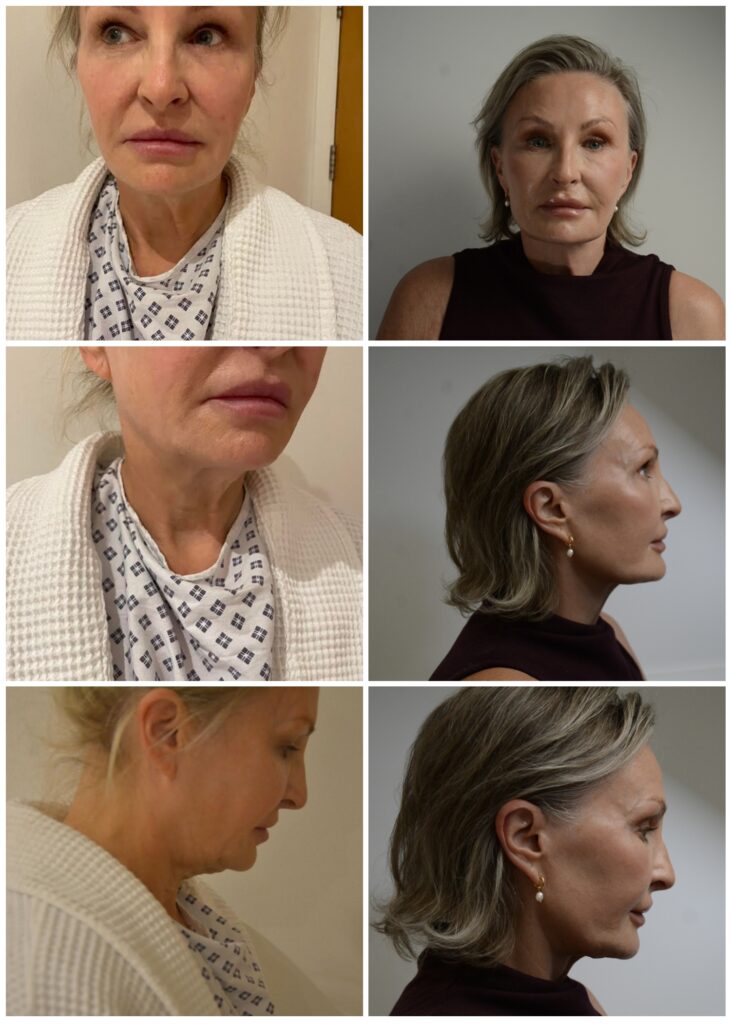
Before and After Images
These images show examples of patient outcomes following treatment with Ms Tzafetta. Every patient is different, and results depend on individual anatomy, the procedure performed, healing, and clinical circumstances. During consultation, Ms Tzafetta will discuss what may be realistic and appropriate for you.
Case 1
Procedure: Rhytidectomy (Facelift Surgery) and Platysmaplasty (Neck Lift)
Timing: 4 Years after surgery
Notes: This 65-year-old patient kindly gave permission for her images to be shared. The photographs show her before and after Rhytidectomy and Platysmaplasty surgery. Each patient’s treatment plan is individual, and results vary depending on anatomy, healing, skin quality and clinical circumstances. Images are shared with patient consent.
Facelift FAQs
How long does facelift surgery take?
Facelift surgery usually takes between 2 to 5 hours, depending on the techniques used and whether it is combined with other procedures. Ms Tzafetta will explain the expected duration during your consultation.
Will I need a general anaesthetic?
Facelift surgery is usually performed under general anaesthesia. Ms Tzafetta will discuss anaesthetic options and hospital stay during consultation.
How long will I need off work?
Most people take two to three weeks away from desk-based work. Those with physically demanding or highly public-facing roles may need longer. Ms Tzafetta will tailor guidance to your role and recovery.
Will a facelift leave visible scars?
Scars usually sit around the ears and hairline and fade gradually over time. Healing, skin type and surgical technique all influence scar appearance, which Ms Tzafetta will discuss with you in advance.
Is facelift surgery painful?
Most people describe recovery as uncomfortable rather than painful. Tightness and soreness tend to peak in the first few days and improve steadily. Pain relief medication helps manage early discomfort.
Will my face look tight or unnatural?
A facelift aims to restore natural facial balance rather than create a tight or artificial appearance. Ms Tzafetta plans surgery around how results will move and age over time.
Can a facelift be combined with other procedures?
Yes. Ms Tzafetta often combines a facelift with procedures such as a neck lift, eyelid surgery or fat transfer when this helps improve overall facial balance.
Who performs facelift surgery?
Ms Tzafetta performs facelift surgery with a focus on facial balance, anatomical precision and long-term outcome quality.
When should I consider a facelift?
You may consider a facelift if facial ageing affects how you feel about your appearance or confidence. Surgery tends to work best when decisions feel unhurried and personal. A consultation with Ms Tzafetta can help clarify whether a facelift suits your goals.
What is a deep-plane facelift, and how is it different?
A deep plane facelift repositions deeper facial tissues rather than tightening skin alone. Instead of lifting only the surface layer, Ms Tzafetta releases and repositions the underlying structures that contribute to mid-face sagging and jowl formation.
This technique can provide more natural movement and longer-lasting support in carefully selected patients. It is not necessary for everyone. During the consultation, Ms Tzafetta will assess your anatomy and explain whether a deep-plane approach is appropriate for you.
Patient Experiences
Many people find it helpful to hear from others who have been through a similar experience. The reflections below share individual patient perspectives, offered to help you understand what care and recovery can feel like in practice.
I would highly recommend Ms Tzafetta
Having had a lower facelift a few years ago which sadly failed, I sought to find the right surgeon to correct this and help lift my sagging jawline and neck. My search led me to Ms Kallirroi Tzafetta who explained the deep plane procedure that she recommended.
The surgery, which I had 4 weeks ago, and the recovery so far has gone a lot smoother than I anticipated and the results to date have been amazing, especially around my neck area. I would highly recommend Ms Tzafetta, her work is simply brilliant.
Great experience from start to finish
I am now 9 weeks post op from having a deep plane lower face and neck lift, and it is time to write about how happy I am with the whole experience.
From the moment I met Ms Tzafetta I felt at ease, even though previously I had felt extremely nervous, she allayed my fears and asked me first what I would like to achieve. I said I wanted to look like me, only better, but above all natural. After examining me, she told me what she could do and what I should expect. She also showed me before and after photographs of previous surgeries. This gave me more confidence in her skills.
I had plenty of time to change my mind after that first consultation but knew I had found the right surgeon and any small doubts I had just disappeared. To summarise I cannot believe what wonderful results she has achieved, Kalliroi is a wonderful person, very caring, skilled, kind and who listened to all my concerns and endless questions.
Together with the great care shown to me by her two plastic surgery nurses, who were so nice, plus the other staff at the Rivers Hospital, Sawbridgeworth, where I stayed overnight, my overall experience has been positive, and I am happy that I took the plunge. I would certainly recommend Ms Tzafetta to anyone who is considering cosmetic surgery. You will not be disappointed.
Further Reading:
British Association of Plastic Reconstructive and Aesthetic Surgeons
 videoandweb.com